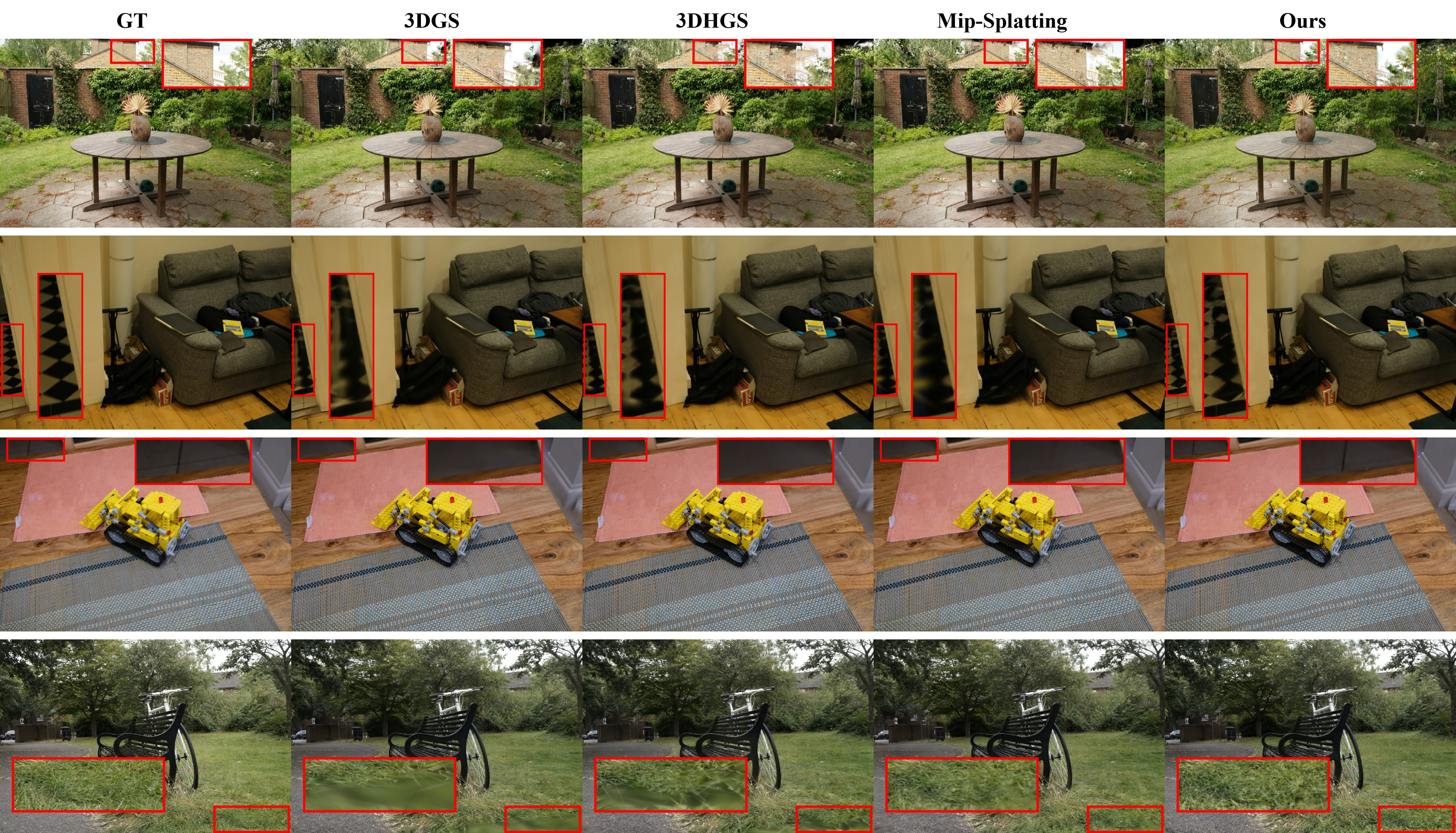
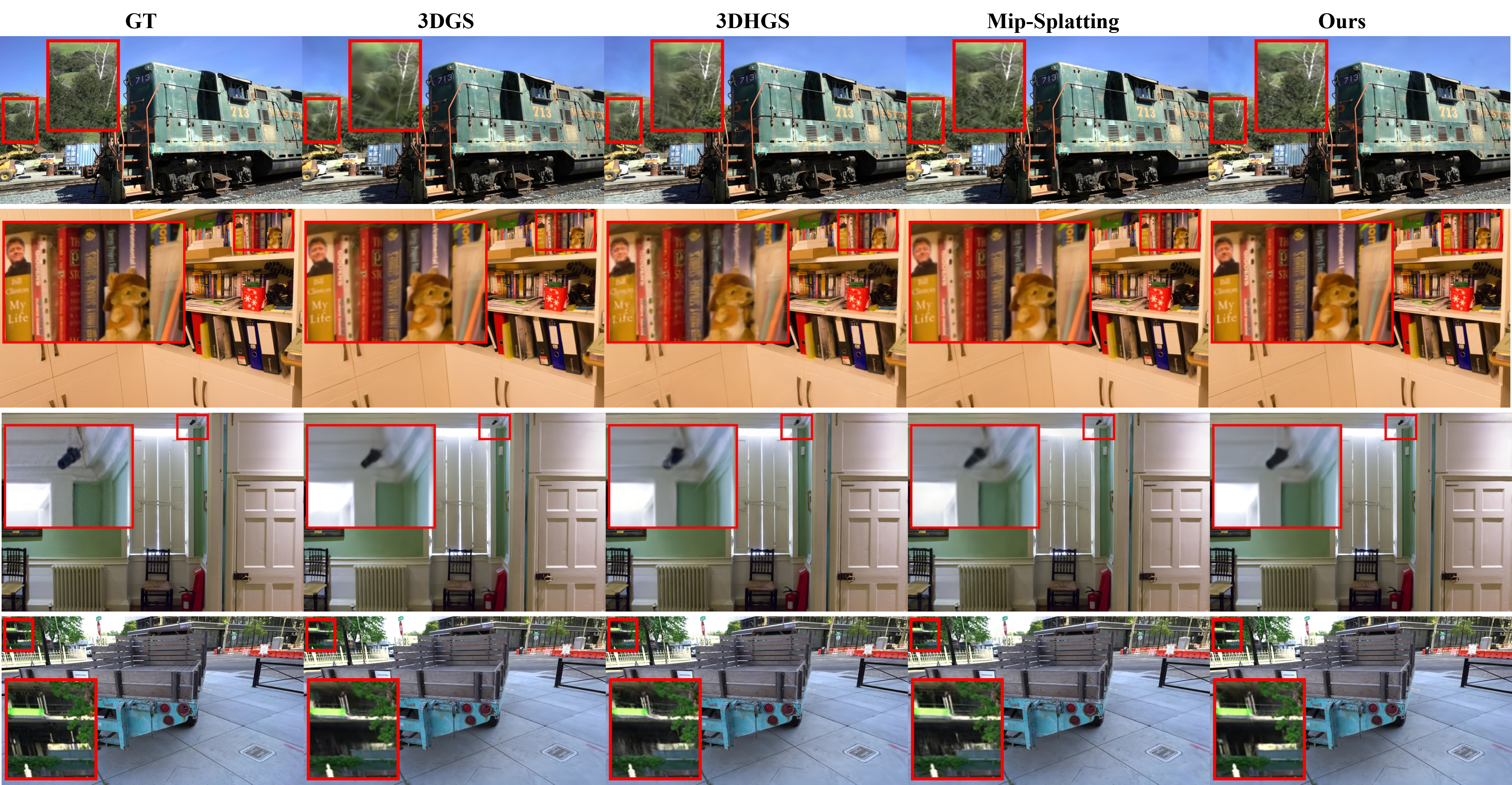
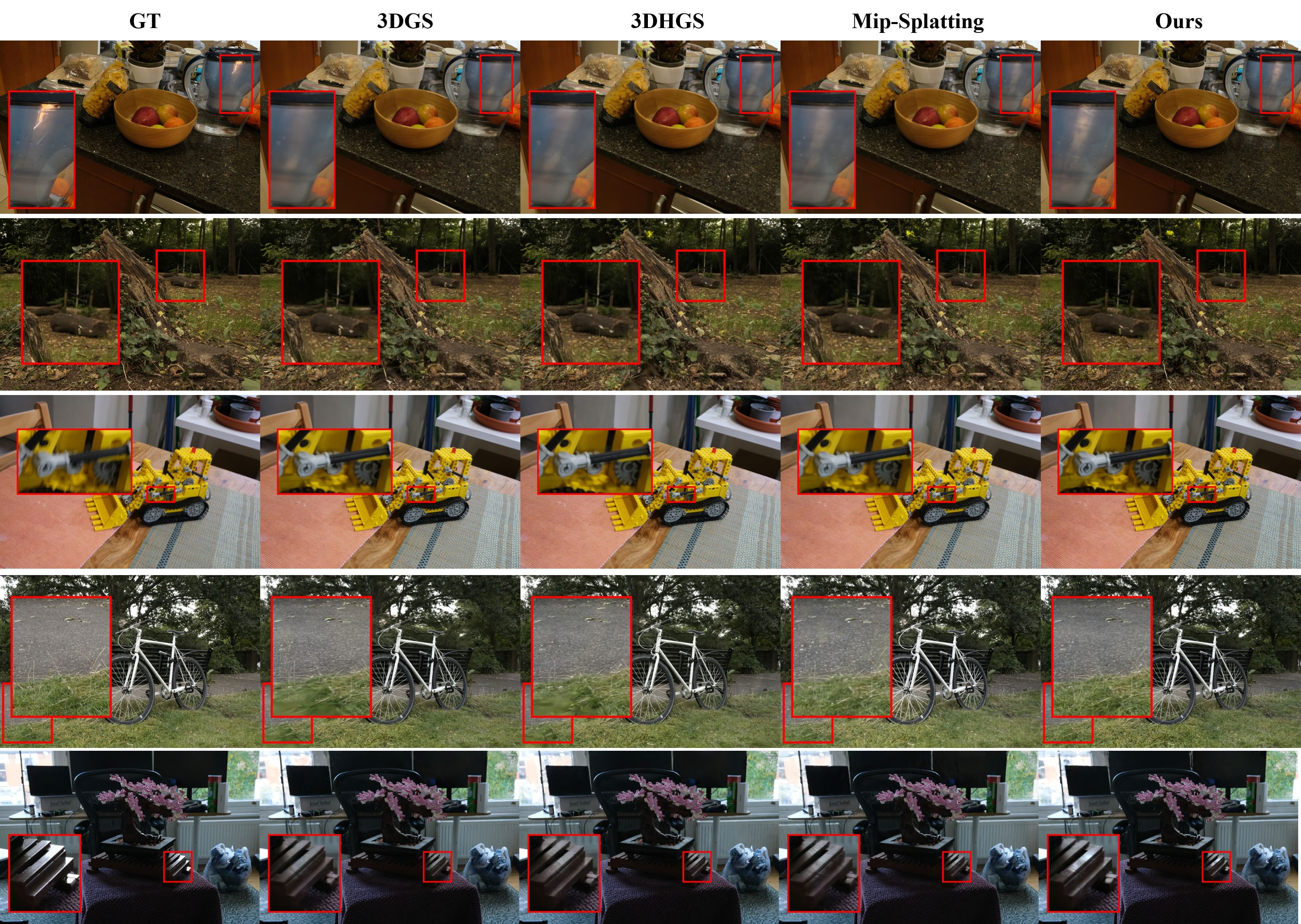
3D Gaussian Splatting (3DGS) has revolutionized 3D reconstruction and rendering, enabling photorealistic novel view synthesis from sparse images. However, the fundamental reliance on 3D Gaussian distributions struggles to capture shape and color discontinuities in real-world scenes, such as sharp edges and intricate surface details. In this paper, we introduce 3DSGS (3D Skew Gaussian Splatting), a novel framework that significantly enhances the accuracy and efficiency of Gaussian- based neural scene representation. Our key insight lies in extending the original 3D Gaussian to its more general Skew Gaussian counterpart, where the original Gaussian distribution emerges as a special symmetric case. This generalized primitive inherits all desirable properties of Gaussians while gaining intrinsic asymmetric modeling capability, enabling more accu- rate representations for complex scenes. Then we propose a refined representation for the opacity parameter, increasing the flexibility of each skew Gaussian to better handle transparency and fine structures. Furthermore, we introduce a depth-aware densification criterion that intelligently manages the creation, splitting, and cloning of skew Gaussians. Extensive experiments demonstrate that 3DSGS achieves superior rendering quality, particularly in regions with intricate details, transparency, and view-dependent effects with real-time rendering speed. The code will be open-sourced upon paper acceptance.
We extend the 3D Gaussians into 3D Skew Gaussians by adding an additional parameter skewness. We derive and implement the splatting pipeline which contains the forward and backward pass of the rasterizer. In the optimization stage, we design a depth-aware densification criterion for more accurate skew gaussians splitting.
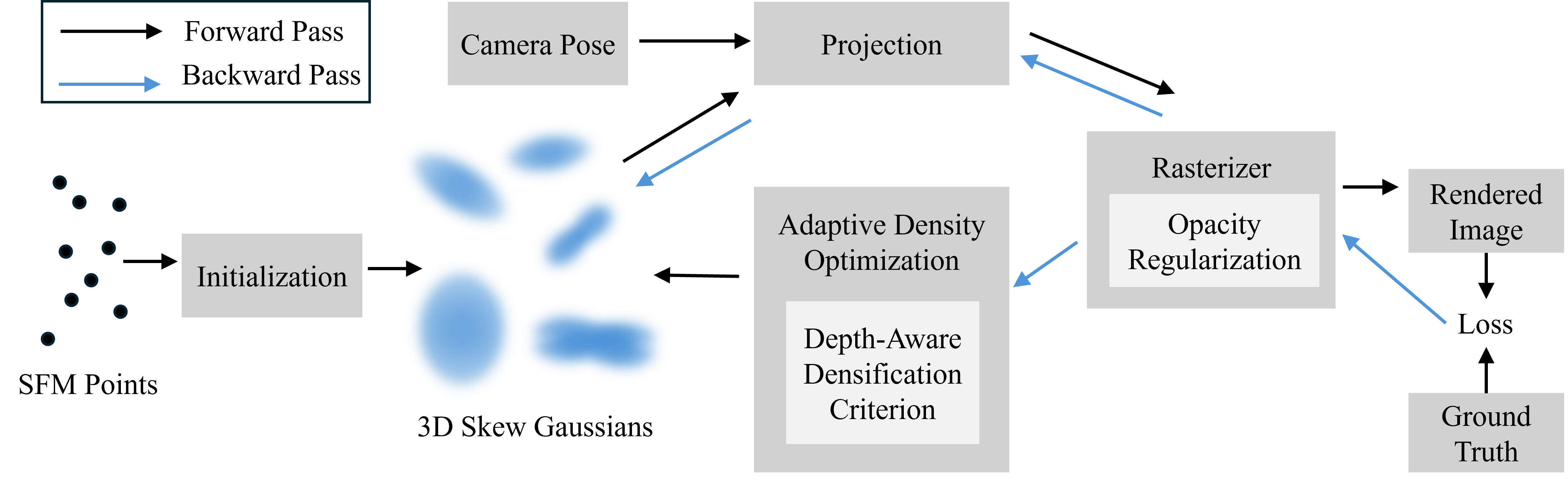
We compare our method with the original 3DGS as well as several recent advancements that focus on core improvements within the 3DGS paradigm, conducting evaluations on three benchmark datasets. For efficiency, we report FPS, training time, and the number of kernels, while for novel view rendering quality, we evaluate PSNR, SSIM, and LPIPS. Compared with baseline methods, our approach achieves a more faithful reconstruction of intricate scene details, while maintaining competitive computational efficiency.
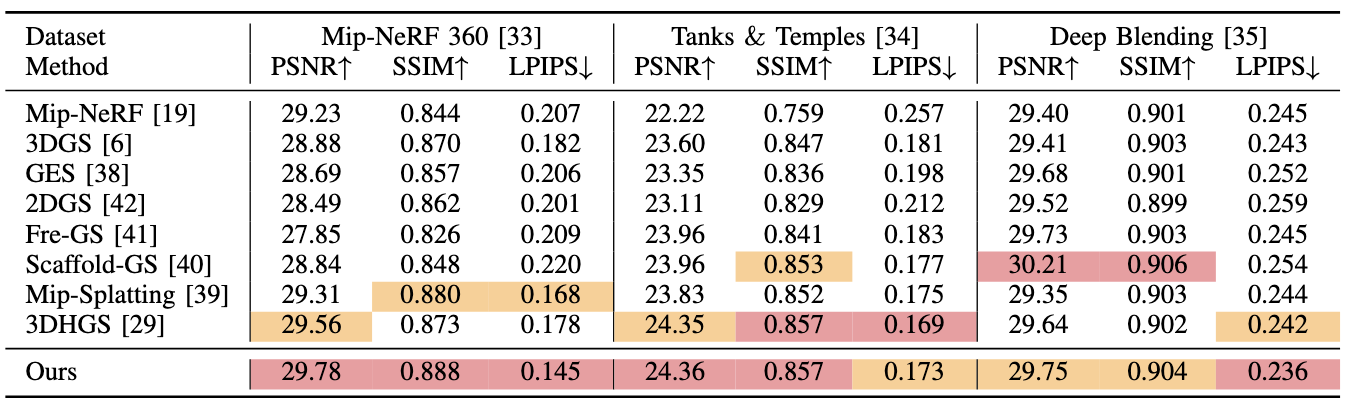
Visual differences are highlighted with red insets for better clarity. Our approach consistently outperforms other models on Mip-NeRF 360, Tanks & Temples and Deep Blending dataset, demonstrating clear advantages in challenging scenarios such as thin geometries and fine-scale details. Best viewed in color.